Who should use this guide?
iManage Work at cloudimanage.com customers
IT help desks and training departments creating tip sheets for their communities
In this guide:
Search guidance for better results
This guide provides comprehensive guidance on how to properly perform searches in iManage Work. If a search doesn't return the document you want, try the following tips before running the search again:
Search for the document using profile fields (metadata), such as the document number, without any full-text criteria. If the document isn't retrieved, the reason may be something unrelated to the search itself, such as the document having been deleted or having security access restrictions.
Check the search query for special characters. Try to reformulate the query with other terms in the target document.
Select the correct library or libraries to narrow down the results.
NOTE: A library is the highest-level container. Only an iManage system administrator can create and name a library. Libraries can hold workspaces, and only workspaces can exist at the root level of a library.
Search interface in iManage Work Web
When performing a simple or advanced search, you can define the scope for each search type along with the search language in which you wish to perform the search.
Table: Search type, search scope, and supported languages
Search type | Search Scope | Locale search support |
|---|---|---|
Documents | In Recent Matters | English, Spanish, Chinese, Japanese, German, French, Portuguese. |
Emails | In Recent Matters | English, Spanish, Chinese, Japanese, German, French, Portuguese. |
Docs & Emails | In Recent Matters | English, Spanish, Chinese, Japanese, German, French, Portuguese. |
Folders | In Recent Matters | Not Applicable |
Matters | In Recent Matters | English, Spanish, Chinese, Japanese, German, French, Portuguese. |
Clients | Scoped to a single library | Not Applicable |
Setting the search scope to In Recent Matters returns results from your Recent Matters list, which is content in the matters that you have accessed during the past 30 days.
Setting the search scope to In Selected Databases returns results from all selected libraries. If your organization has only one library, then the same is available to you in the search scope. If your organization has multiple libraries, then either all libraries or ones that you are granted access to are available in the search scope.
NOTE: Language search support is available only if your company administrator has enabled Enable Search Language Selection in iManage Control Center.
Simple search
Searching for Documents
Figure: Performing a Simple search for documents
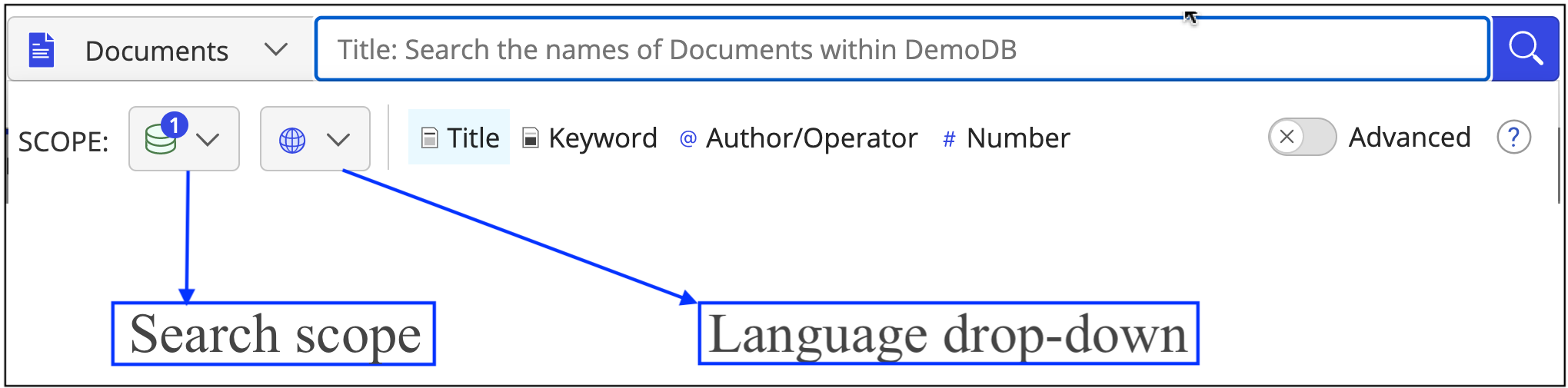
From the search type drop-down list, select Documents.
Select inside the search box and the list of options is displayed:
Title: This is the default option. Title search is performed for document titles; that is, documents are returned in the search results only if the search term is a part of the document title. If you have been using iManage Work 9.x, the Title field corresponds to the Document Name or Document Description fields that you may be familiar with.
Keyword: The Keyword search for documents performs a full-text search; this means it looks for your search term anywhere in the document, including the text of the document, title of the document, and metadata fields used for the document. You can also manually enter Keyword:<search string> in the search bar to perform this type of search.
Author/Operator: This search is performed if you are searching for individuals associated with a document. While entering the name of the user, you can use the @ symbol followed by the user name to display the list of users with similar names. This helps you select the required user without having to type the name fully. For example, @Jo displays all names that have the string Jo in them, such as John, Joseph, and Joe. Entering a space stops suggestions from being triggered.
Number: The Number search performs the search on the Document Number. It does an exact number search across the entire library, even if you are within a folder. As a quick search option, in iManage Work 10 clients, you can enter the pound (#) sign in the search bar, followed by the document number. For example—entering #10 would search for document number 10.
NOTE: You can either set Title or Keyword as the default search value by selecting it in the search box. The default is highlighted in blue. Your selection persists unless you change it again. If Keyword isn't set as default, the default search criteria continues to be Title search for documents.
For the supported search operators, refer to Boolean Operators Search.
Start by entering the search term in the Search box and press Ctrl+Enter or Enter. The results list is narrowed down to display the documents that meet your search criteria.
Searching for Emails
Figure: Performing a Simple search for emails
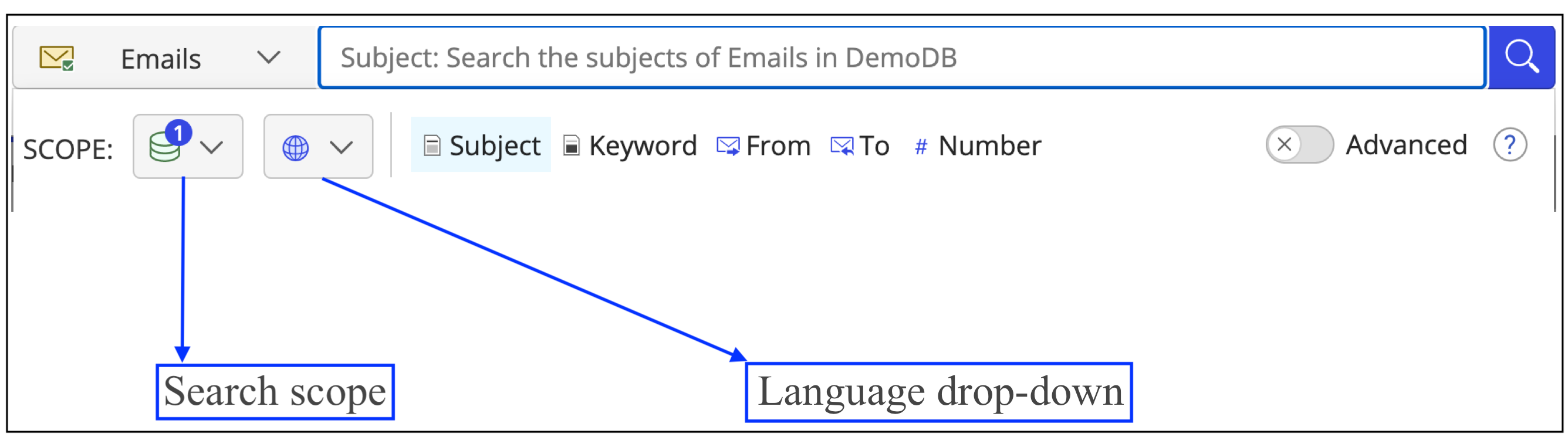
From the search type drop-down list, select Emails.
Select inside the search box and the list of options is displayed:
Subject: This option is the default. Subject search looks for the search terms in the subject line of the emails.
Keyword: Performs a full-text search of emails, meaning it looks for your search term anywhere in the email, including the email body, subject, attachments (if any), and metadata fields.
From: Looks for the user(sender) in the From field of an email. You can search using first or last names.
To: Looks for the users (recipients) in the To field of an email.
Number: Performs a search for the Document Number. It does an exact number search across the entire library, even if you’re within a folder. As a quick search option in iManage Work 10 clients, you can enter the pound (#) sign in the search box, followed by the document number. For example, entering #10 would search for document number 10.
NOTE: You can either set Subject or Keyword as the default search value by selecting it in the search box. The default is highlighted in blue. Your selection persists unless you change it again. If Keyword isn't set as default, the default search criteria continues to be Subject search for emails.For supported search operators, refer to Boolean Operators Search.
Start by entering the search term in the Search box and then pressing Ctrl+Enter or Enter. The results list is narrowed down to display the emails that meet your search criteria.
Searching for Docs & Emails
Figure: Performing a Simple search for Docs & emails
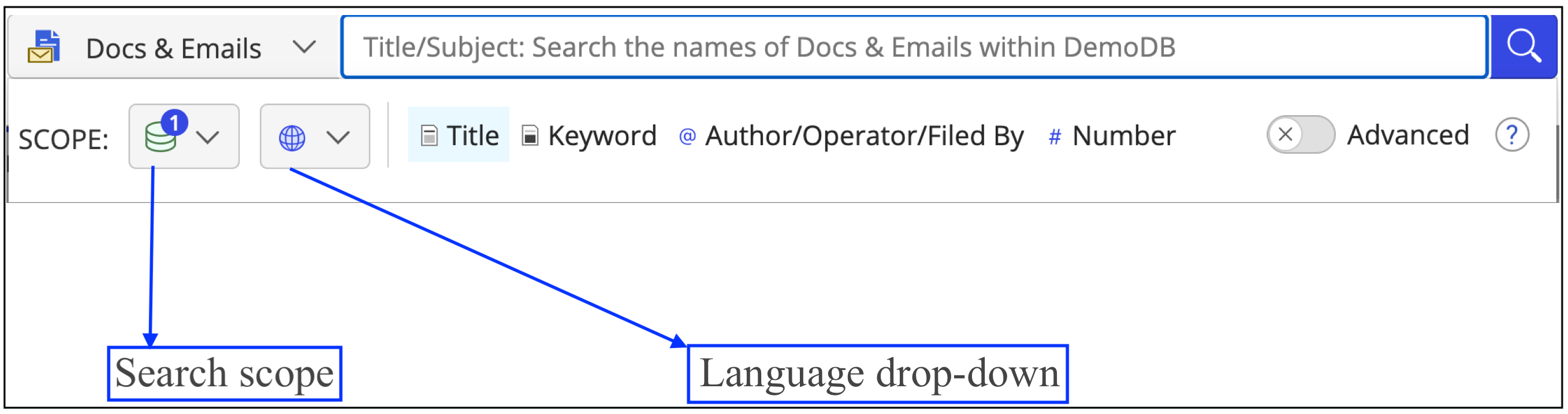
From the search type drop-down list, select Docs & Emails.
Select inside the search box and the list of options is displayed:
Title/Subject: This option is the default. Title search is performed against document titles; that is, documents are returned in the search results only if the search term is a part of the document title. Subject search looks for the search terms in the subject line of the emails.
Keyword: Performs a full-text search of emails, meaning it looks for your search term anywhere in the email, including the email body, subject, attachments (if any), and metadata fields. The Keyword search for documents performs a full-text search which means it looks for your search term anywhere in the document, including the document body, title, and metadata fields.
Author/Operator/Filed By: This search is performed if you’re searching for individuals associated with a document or email. While entering the name of the user, you can use the @ symbol followed by the user name to display the list of users with similar names. This input helps you select the required user without having to type the name fully. For example, @Jo displays all names that have the string Jo in them, such as John, Joseph, and Joe. Entering a space stops suggestions from being triggered.
Number: The Number search performs the search on the Document Number. It does an exact number search across the entire library, even if you are within a folder. As a quick search option, in iManage Work 10 clients, you can enter the pound (#) sign in the search bar, followed by the document number. For example, entering #10 would search for document number 10.
NOTE: You can either set Title/Subject or Keyword as the default search value by selecting it in the search box. The default is highlighted in blue. Your selection persists unless you change it again. If Keyword isn't set as default, the default search criteria continues to be Title/Subject search for docs and emails.
Start by entering the search term in the Search box and then pressing Ctrl+Enter or Enter. The results list is narrowed down to display the docs and emails that meet your search criteria.
Searching for Folders
Figure: Performing a Simple search for folders

From the search type drop-down list, select Folders.
Select inside the search box, enter the name of the folder that you want to search, and then press Ctrl+Enter or Enter. The results list is narrowed down to the folders that meet your search criteria.
Searching for Matters
Figure: Performing a Simple search for matters
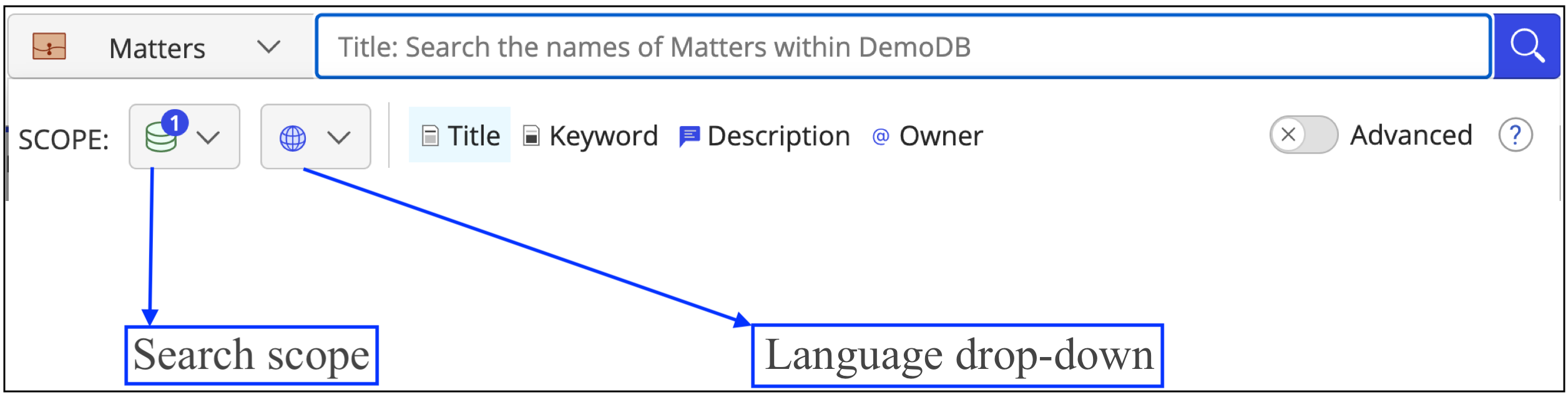
From the search type drop-down list, select Matters.
Select inside the search box and the list of options is displayed:
Title: This is the default option. Title search is performed against the matter names; that is, matters are returned in the search results only if the search term is a part of the matter name.
Keyword: The Keyword search for matters performs a full-text search; this means it looks for your search term anywhere in the matter, including:
Workspace Name
Workspace Description
Custom metadata fields
NOTES:
Full-text search is limited only to the above-mentioned fields.
You can either set Title or Keyword as the default search value by selecting it in the search box. The default is highlighted in blue. Your selection persists unless you change it again. If Keyword isn't set as default, the default search criteria continues to be Title search for matters.
Description: Description search is performed for the description of the matter, which typically is used to outline particular information about a matter that might not be covered using the name.
Owner: The Owner search looks for matters based on the owner of the matter.
Start by entering the search term in the Search box and then pressing Ctrl+Enter or Enter. The results list is narrowed down to display the matters that meet your search criteria.
Searching for Clients
Figure: Performing a Simple search for clients

From the search type drop-down list, select Clients.
Select inside the search box and enter the name of the client that you want to search for and press Ctrl+Enter or Enter. The results list is narrowed down to clients that meet your search criteria.
NOTES:Client search performs a Contains search as opposed to a Begins with search. Searching with the string Go would return all clients with Go in the name. For example, Goldberg and Snider Go.
Client search is always set to a library and you can select only one library.
Recent Searches
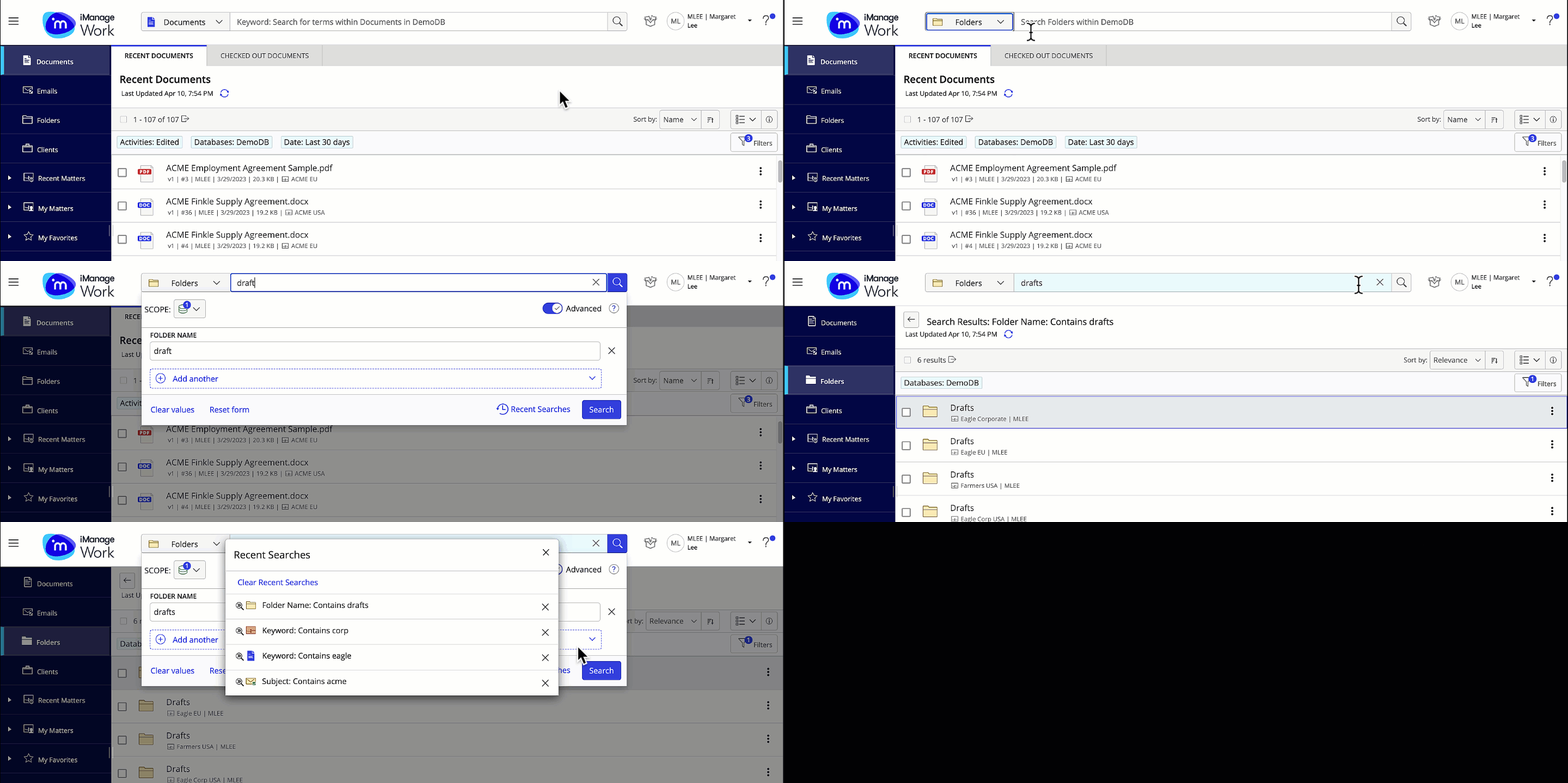
If you have previously searched for content, the Recent Searches list displays the last five searches. You can remove any of the displayed searches in the list by selecting X. You can also delete all the searches at once by selecting Clear Recent Searches.
Figure: Recent searches in simple search
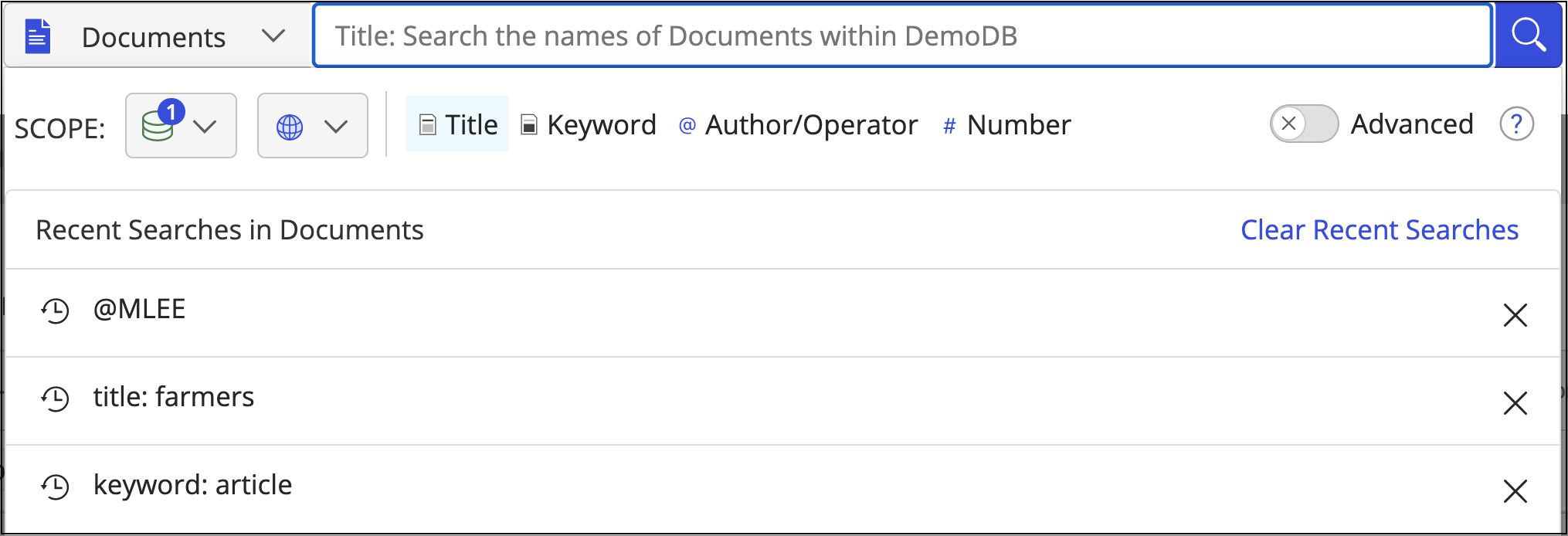
Figure: Recent searches in Advanced search
NOTES:
You can select any of your recent searches to re-run that search.
The results displayed under Recent Searches are interface-dependent (iManage Work Desktop for Windows or iManage Work Desktop for Mac clients or iManage Work Web).
Simple Search behavior examples
NOTE: Title search is the default search used. Select the Keyword option if you want the entire document, including metadata fields to be searched.
Table: Simple search behavior examples
Search Terms | Type of Search | Search Results | Applies to |
|---|---|---|---|
Agrees | Search for terms and their variations | Documents containing the stemmed variations of the terms. For example:
| Documents Emails Docs & Emails Matters Clients |
Credit Agreement | Search for phrases and their variations | Documents containing both the terms, irrespective of their location in the document, and their stemmed variations.
For example: credit agreement, credit, creditor, agreement, agree, agreements, and agreed | Documents Emails Docs & Emails Matters |
Document#11 1233 12345 | Search for numbers or alphanumeric terms in the Title field and anywhere in the document The difference between searching for numbers and alphabetical characters is that terms that are purely numeric or alphanumeric don't stem at all. | Documents containing the search string (all numbers as the default operator is AND) anywhere in them. For example:
| Documents Emails Docs & Emails Folders Clients |
Search for numbers or alphanumeric terms in the document content The difference between searching for numbers and alphabetical characters is that terms that are purely numeric or alphanumeric don't stem at all. When the search is performed on document content, Alphanumeric or Numeric terms may be up to 255 numbers/characters. | Documents containing the search string (all terms as the default operator is AND) anywhere in them. For example: The results include documents that have Document#11, 1233 anywhere in the document content. | Documents Emails Docs & Emails Matters Folders Clients | |
10/29/17 | Search for dates in full-text When searching for dates in full-text, special characters (such as slashes, hyphens) are interpreted as spaces; so this becomes a search for 10 AND 29 AND 07 and returns documents having all of these three numbers in any order. NOTE: Because slash is a special character, the search returns documents with numbers that include other special characters as well. | For example: Documents containing 10/29/07, | Documents Emails Docs & Emails Matters |
553* | Number search with wildcards Operator: * (asterisk) Use the wildcard in place of any unknown characters. Wildcards can't be the first or second character of your term, for example, these searches would be invalid: from:'*ajubalaw.com' | Documents containing the search number or alphanumeric term fragment. | Documents Emails Docs & Emails Folders Matters Clients |
rou* | Document search with wildcards Operator: * (asterisk) Use * as a wildcard in place of any number of unknown characters. from:'*ajubalaw.com" | Documents containing words that include the search string and the missing character or characters. For example: Route and Rounded | Documents Emails Docs & Emails Folders Matters |
Agree? | Search with wildcards Operator: ? (question mark) Use ? as a wildcard in place of a 0 or 1 unknown character. Wildcards can't be the first or 2nd character of your term, for example, these searches would be invalid: title: 's?op' | Documents containing words that include the search term and the missing character ? in the exact location. | Documents Emails Docs & Emails Matters |
Agreement AND Credit | Search for documents containing two specific terms in Title and Keyword searches. Operator: AND The operator must be in uppercase (AND). | Documents containing both the search terms in any order. For example: Searching for a document with Agreement AND Credit returns:
| Documents Emails Docs & Emails Matters |
Agreement OR Credit | Search for documents that contain either (or both) of your search terms in Title and Keyword searches. Operator: OR The operator must be in uppercase (OR). It increases the search scope and is normally used to look for terms that have similar meaning or refer to similar subjects. | Documents containing at least one of the terms in any order. For example: Searching for a document with Agreement OR Credit returns:
| Documents Emails Docs & Emails Matters |
Agreement NOT Credit | Search for documents that exclude a specific term. Operator: NOT The operator must be in uppercase (NOT). | Documents containing the term Agreement and that don't contain the term Credit. For example: Searching for a document with Agreement NOT Credit returns:
But wouldn't return:
| Documents Emails Docs & Emails Matters |
(Agreement AND Credit) NOT Loan | Logical Operator Combination (AND NOT, OR NOT) Search for documents by a specific combination of inclusion and exclusion of terms. AND NOT OR NOT ( ) The operators must be in uppercase (AND NOT). Don't place any part of the search term in "" as an indication of priority. The system reads the order of the operators from left to right. Any terms placed within () are read as a unit. | Documents containing the terms Agreement and Credit in any order but not containing the term Loan. For example: Searching for a document with (Agreement AND Credit) NOT Loan returns:
But wouldn't return:
| Documents Emails Docs & Emails Matters |
Agreement OR Credit NOT Loan | Logical Operator Combination (AND NOT, OR NOT) Search for documents by a specific combination of inclusion and exclusion of terms. Operator: OR NOT The NOT operator takes precedence over other operators in the absence of brackets. The example search is the equivalent of Agreement OR (Credit NOT Loan). | Documents containing either the term Agreement, or containing the term Credit without the term Loan. For example
If you wish to search for either/both of the first terms in the example and not the last term, you'd need to search (Agreement OR Credit) NOT Loan. This ensures the OR applies before the NOT. For example
| Documents Emails Docs & Emails Matters |
Credit NEAR5 Agreement | Search for documents where the search terms are within a specified distance n of one another. n defaults to 5, if not specified. Phrase Proximity isn't used with NEAR0. | Documents containing both the terms where the second term is within the specified distance of the first one on either side of its occurrence are returned in the search results.
For example: Looking for documents with the words Credit and Agreement within five words of each other would return the following:
Credit Note and Revolving Facilities Agreement with Letter of Credit | Documents Emails Docs & Emails Matters |
Advanced Search
Advanced Search overview
Advanced Search options and examples
Advanced Search overview
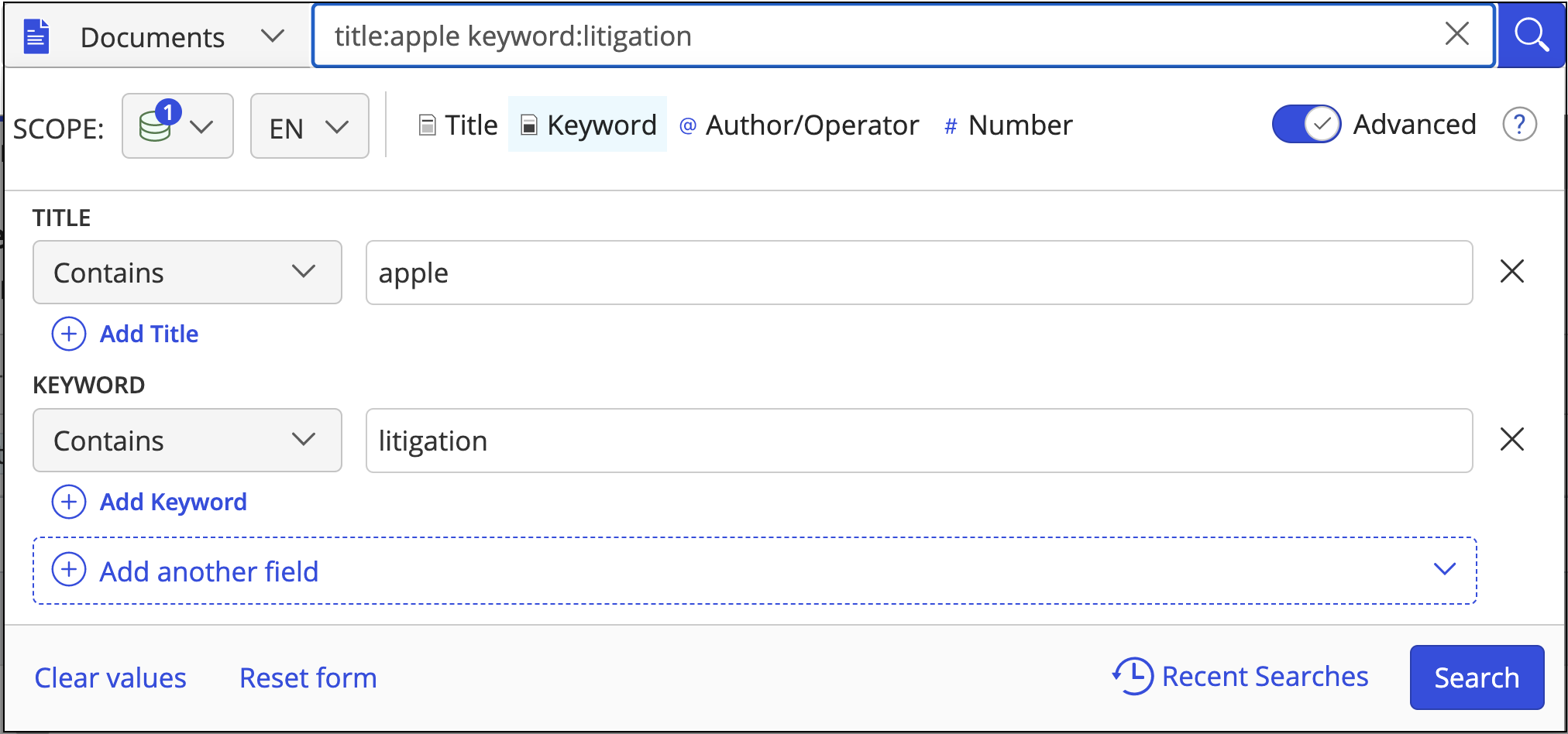
The Advanced Search interface provides search fields that you can use to refine the search results that iManage Work returns. When you enter a query in the simple search box and toggle (enable) to Advanced search, the query is automatically entered into the respective field in Advanced Search.
Advanced Search in iManage Work Web client
Advanced Search in iManage Work Desktop for Windows client

From the search type drop-down list, select one of the following:
Documents
Emails
Docs & Emails
Matters
Folders
Select inside the search box and then turn on the Advanced toggle.
Use the scope and the language drop-down to predefine the search scope and search language.
From the search field drop-down list, select the type of search you want to run. In the text fields, enter the text you want to search for.
For example, the following figure shows the results for a document search where:The document must contain the word apple only in the Title and
The keyword litigation must appear (Contains) in the title, description, or any metadata of the document.
Figure: Advanced search using the Title and Keyword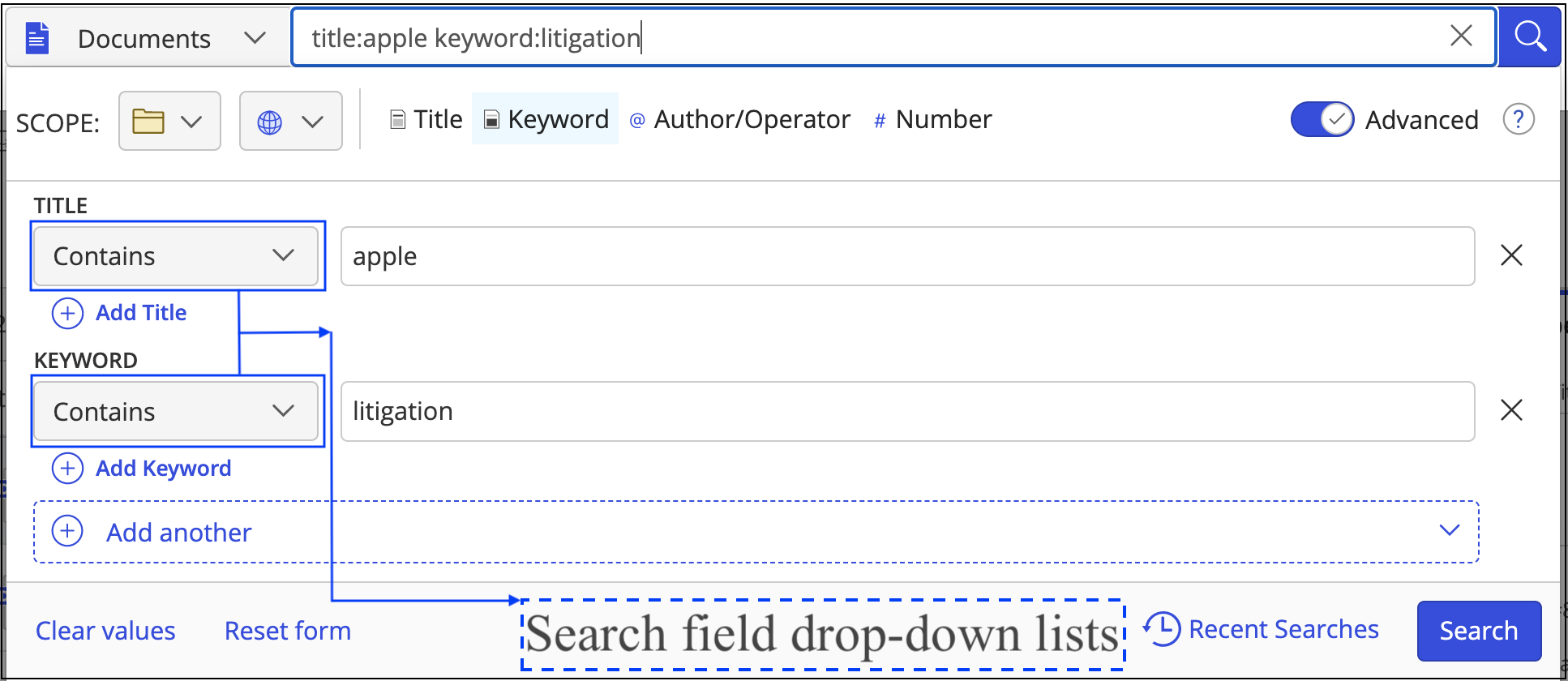
Optional:
To add more levels of search criteria and narrow your search, select Add Another or Shift+Enter.
To remove a search criteria, select
 next to it.
To clear all text fields, select Clear values.
To reset the search form to the default search fields, select Reset form.
Select one of the following options:
In Recent Matters: To display results from your Recent Matters list, which is content that you have accessed in your matters in the past 30 days.
In Selected Databases: To display matching documents in the search results.
NOTE:
To perform a Number search separated by a comma in the new Advanced Search, you must select Doc. Number+Multiple values as shown in the figure below, or if you type this in the simple search Number field, it'll auto-populate in the advanced search field.
Figure: Performing a Advanced search with multiple document numbers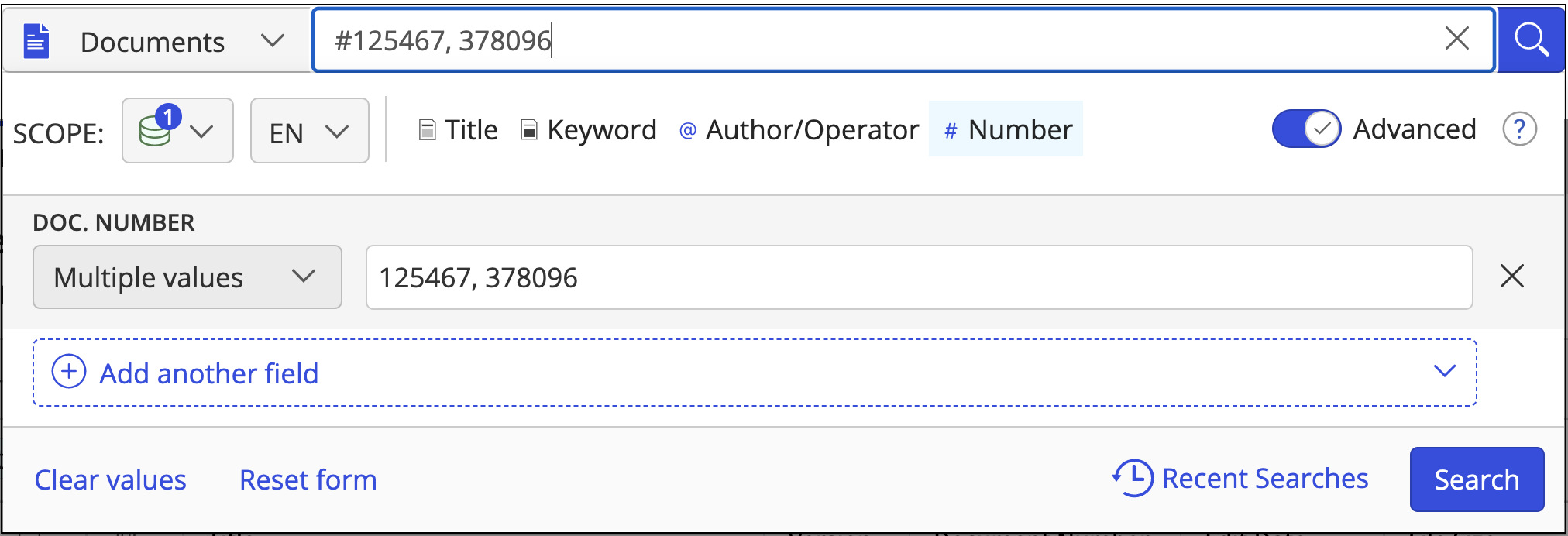
You can add a combination of logical operators (AND, OR, NOT) in one option—for example:
Keyword → Contains → apple NOT samsung
Or, you can progressively use multiple options—for example:Keyword → Contains → apple & Keyword → Does Not Contain → samsung.
The results for the examples above are the same.
Advanced Search options and examples
To get targeted search results, the Advanced search feature provides various options, as applicable in different search fields. Some of the important options are explained in the following table:
Table: Advanced search examples
User Interface | Search Option | Search Description | Example |
|---|---|---|---|
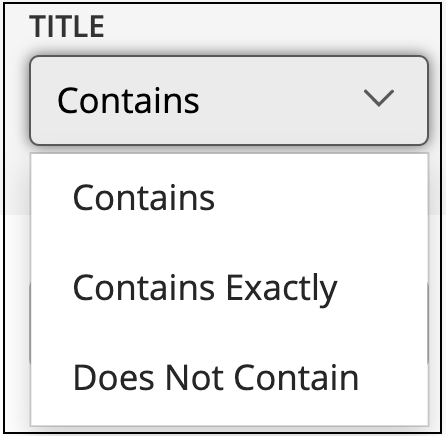 These options are available under Title. You can use a combination of one or more of these options, any number of times, to refine your results. For example:
| Contains (Stemming applicable) | Documents/Emails/Matters containing the term or variations of the term are returned in the search results. If you search for the term credit in the Title and select the Contains option, the system returns all the documents that contain the term or its variations in the Title of the documents. | Input: Credit Output: Credit Agreement with A&G and Revolving Facilities Agreement with Creditor. |
Contains Exactly (Stemming not applicable) | Documents/Emails/Matters containing the exact term or phrase are returned in the search results. If you search for the term Credit Agreement in the Title and select the Contains Exactly option, the system returns all the documents that contain the term/phrase in the Title of the documents. | Input: Credit Agreement Output: Credit Agreement with A&G | |
Does Not Contain | Documents/Emails/Matters that contain these terms are excluded from the search results. | Input: Credit Output: Every document that doesn't have the term credit is returned in the search results. | |
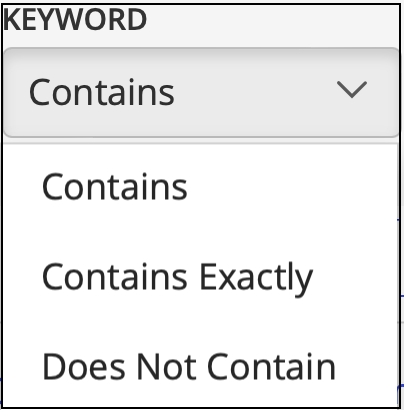 These options are available under Keyword. | Contains | Documents/Emails/Matters containing the term or variations of the term in the document title, description, or metadata are returned in the search results. If you search for the term credit as the keyword and select the Contains option, the system returns all the documents that contain the term or its variations anywhere in the document. | Input: Credit Output: Credit Agreement with A&G and Revolving Facilities Agreement with Creditor. |
Contains Exactly | Documents/Emails/Matters containing the exact term or phrase in the document title, description, or metadata are returned in the search results. If you search for the term Credit Agreement as the keyword and select the Contains Exactly option, the system returns all the documents that contain the term/phrase in the order you typed in the title, description or metadata of the document. | Input: Credit Agreement Output: Credit Agreement with A&G | |
Does Not Contain | Documents/Emails/Matters that contain the keyword are excluded from the search results. | Input: Credit Output: Every document that doesn't have the term credit is returned in the search results. | |
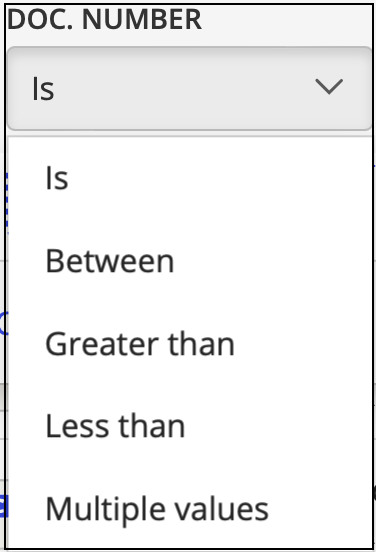 These options are available under Doc. Number. | Is | The document returned exactly matches the document number entered. If you search for the number 45678, and select the Is option, the system returns the documents whose ID is 45678. NOTE: Document numbers themselves must be entered without any commas. | Input: 45678 Output: Document Number 45678 |
Between | The documents with numbers falling between the specified document numbers are returned. If you search for documents within a range, then enter the document numbers within which you want to search, and select the Between option. The system returns documents falling between those numbers. | Input: 45678 and 45690 Output: All documents from 45678 to 45690 are returned (inclusive). | |
Greater than | Documents with numbers greater than the entered document numbers are returned. If you want to search for documents with document numbers falling after the entered number, enter the document number, and select the Greater than option. The system returns the documents falling after the specified number. | Input: 45678 Output: Documents with numbers > 45678 | |
Less than | Documents with numbers less than the entered document numbers are returned. If you want to search for documents with document numbers falling before the entered number, enter the document number, and select the Less than option. The system returns the documents falling before the specified number. | Input: 45678 Output: Documents with numbers < 45678 | |
Multiple values | Multiple specific documents may be searched for, separated by a comma. If you search for ‘45678, 56789’ the system returns both the documents with those IDs. | Input: 45678, 56789 Output: Document Number 45678, Document Number 56789 | |
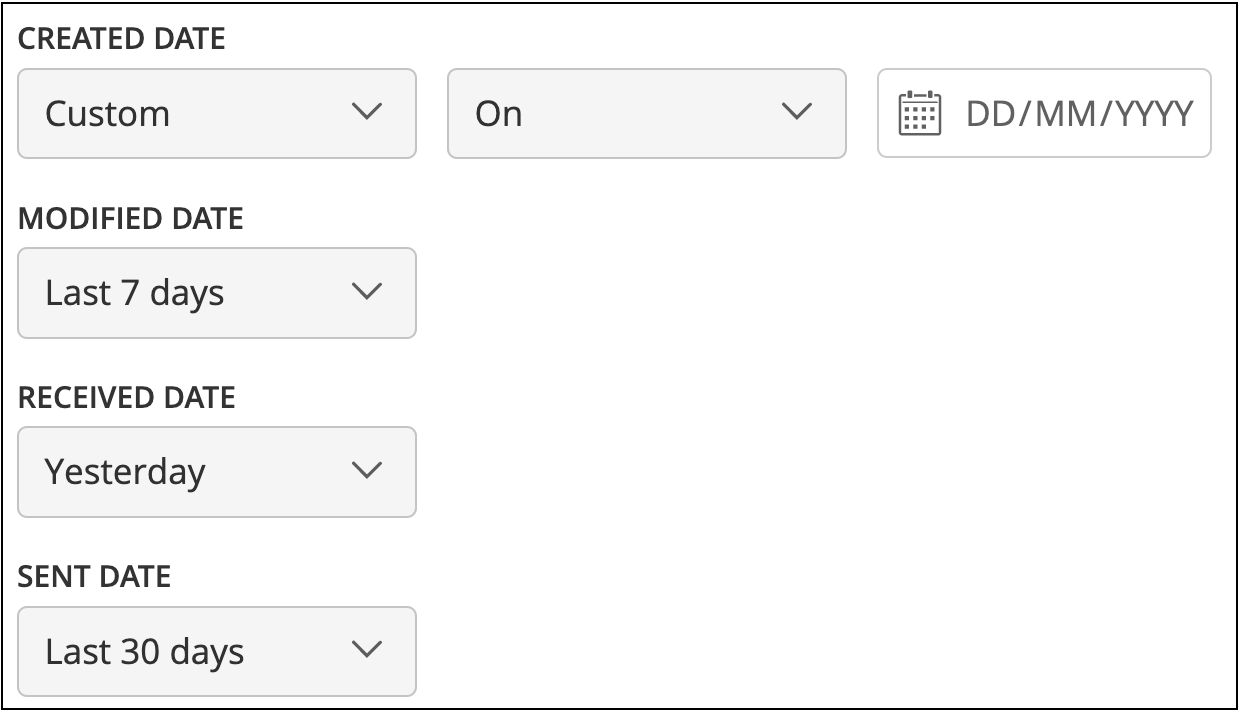 These options are available under the Date fields:
| Custom | Based on the field selected, say Created Date, all the documents that were created on a custom date are returned. | Input: 1/16/2019 Output: Documents that were created on the selected date. |
Today | Based on the field selected, say Created Date, all the documents that were created today (current date) are returned. | Input: No additional selection is required. Output: Documents created on the current date. | |
Yesterday | Based on the field selected, say Created Date, all the documents that were created yesterday are returned. | Input: No additional selection is required. Output: Documents created on the previous day. | |
Last 7 days | Based on the field selected, say Created Date, all the documents that were created over the last 7 days starting from the current date are returned. | Input: No additional selection is required. Output: Documents created over the last 7 days starting from the current date. | |
Last 30 days | Based on the field selected, say Created Date, all the documents that were created over the last 30 days starting from the current date are returned. | Input: No additional selection is required. Output: Documents created over the last 30 days starting from the current date. | |
 For example: Client and Matter, and Customer ID and Account ID | Validated Fields (Parent-Child Relationship) | These are drop-down lists displaying the values that you can choose from. Based on the value selected, all related documents are returned. There's a parent-child association here. For example, based on the Custom 1 selected, the list of Custom 2 values is populated in the drop-down list. NOTE:
| Input: General Insurance (2080) Output: Documents associated with the specified account ID. |
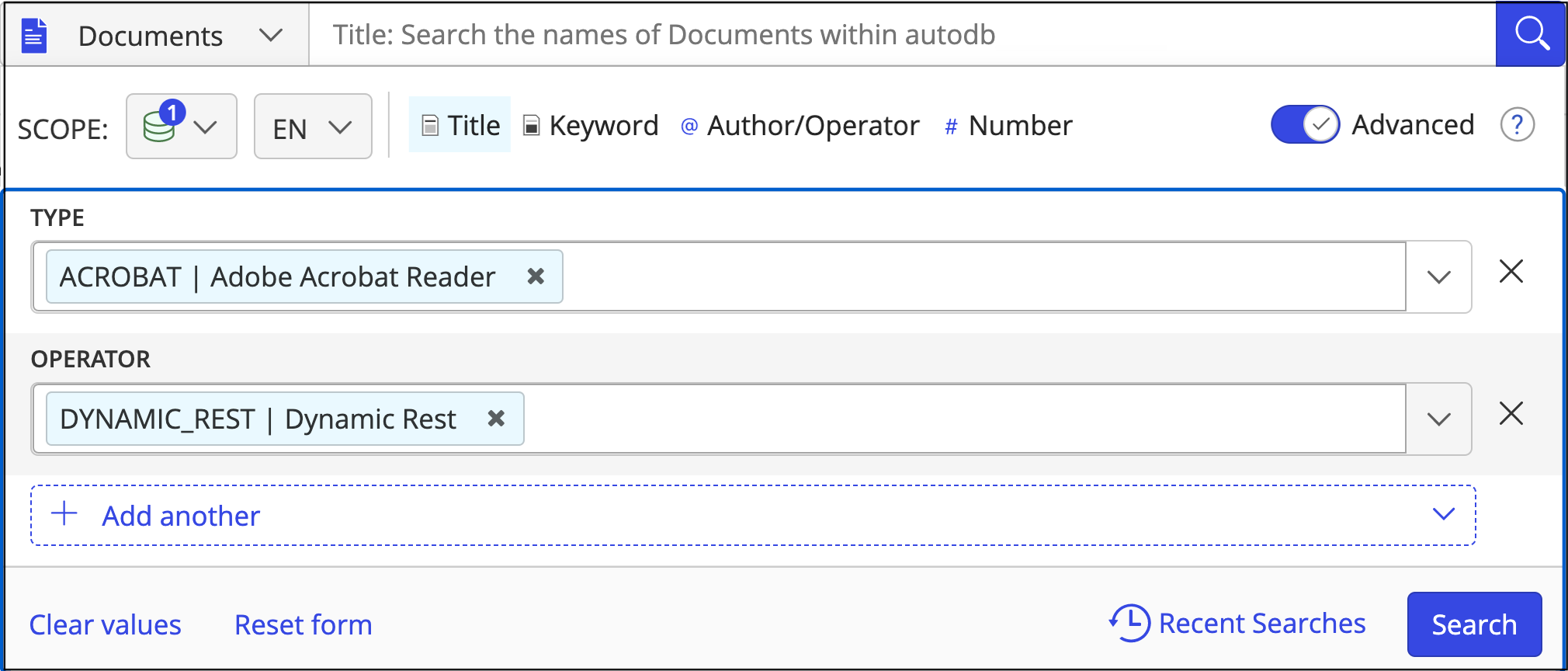 For example: Author, Operator, Type, and Status | Validated Fields | These are drop-down lists displaying the values that you can choose from. Based on the value selected, all related documents are returned. | Input: Type and Operator Output: Documents of the acrobat type with operator DYNAMIC_REST are returned. |
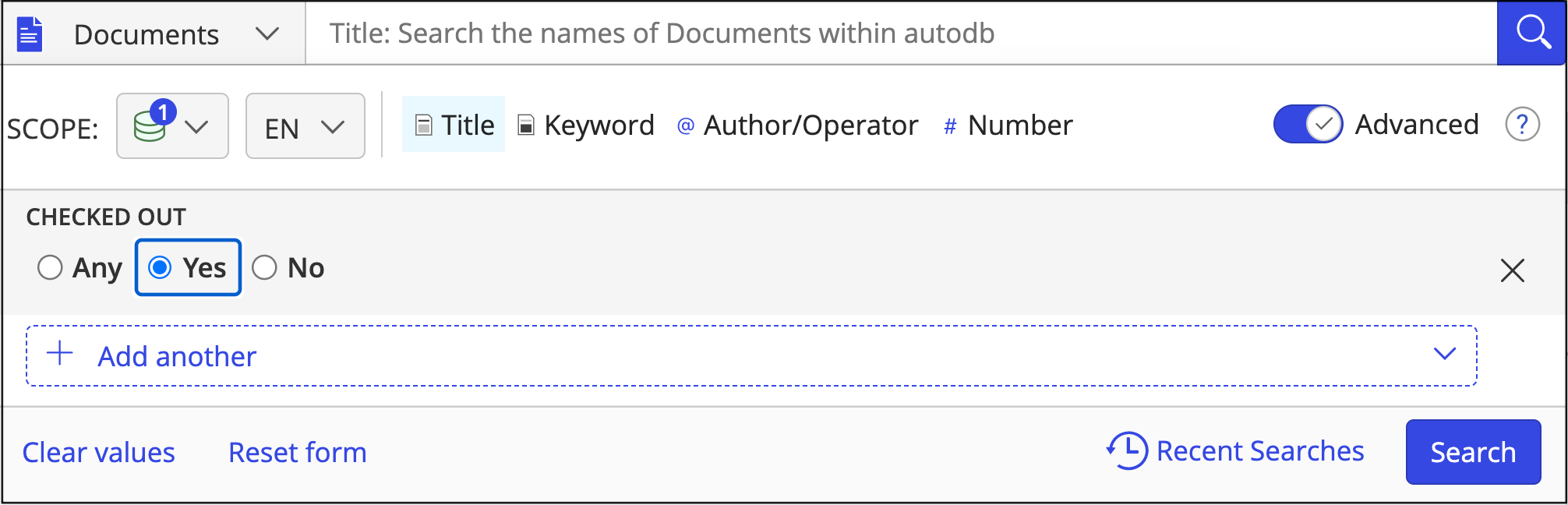 | Boolean Fields | If your instance of iManage Work is configured for fields that accept Boolean fields, then based on your selected response, all the related documents are returned. Selected response: Any: system skips the search. For example—when you use the Checked Out search field, the system returns all documents that have been checked out when you specify Yes in your search criteria for this field. | Input: Yes Output: Documents conforming to your selection are returned. |
Types of searches in iManage Work
Full-text search
When searching through Documents, the search used most often is the Keyword or Title (default) search.
When searching for Emails, it's Subject (default), From, To and Keyword.
For Matter search, it's Title, Description, and Keyword.
If you perform a client-level search, the client list conforming to your entered search criteria is displayed. The default behavior returns documents that contain each search term, as well as variations, in any order.
Searching for an exact match (exact word or exact phrase)
It's important to understand the default search behavior when conducting a search. There are two base rules whenever you search in the full-text search fields:
First, each search term is separated by an implicit AND operator:
The AND operator returns documents containing all of the specified terms, in any order.
For example, a search for 'credit agreement' is treated as a search for 'credit AND agreement' and returns documents that contain both terms, in any order.
Second, searches by default include stemmed variations of each term:
For example, a search for 'credit agreement' returns documents with variations of the root of each word.
This means credit as well as credits, credited, and crediting are returned.
If you wish to modify this default behavior, you can search for an exact match term or phrase, using double quotes ("") or Contains Exactly.
In simple search, enter your term in double quotes—for example,"Credit agreement".
The terms are returned in the exact order in which you typed them:
Only documents which contain these terms in the same order, not the individual words in any order, are returned.
For example, a search for “Credit agreement” returns items containing ‘credit agreement’ and not items containing only ‘credit’, ‘agreement’, or ‘agreement credit’.
NOTE: It's possible that the individual terms may still appear elsewhere in the document.
The terms aren't stemmed—no variations are returned
For example—“Credit agreement” wouldn't return ‘creditor agreement’, or ‘credit agreements’.
NOTE: For Keyword searches, unstemmed variations of hits in the body text aren’t supported.
In Advanced search, select Contains Exactly in the search options.
The terms are returned in the exact order in which you typed them
For example, a phrase search for ‘credit agreement’, where the selected option is Contains, returns documents with those terms in any order.
A search for credit agreement with Contains Exactly selected returns only documents that contain the phrase ‘credit agreement’ in that exact order.
The terms aren't stemmed—no variations are returned
For example—a search for help, where the selected option is Contains, returns documents that contain the words helps, helpful, and helping.
A search for help with the Contains Exactly option selected returns only documents with the exact term help and no variations.
For Keyword searches, unstemmed variations of hits in body text aren’t supported.
NOTES:
Searching for an exact match within double quotes isn't supported for Clients.
In addition to the Keyword field, Description field, and the document content, non-validated custom text fields are also treated as full-text fields in a search. The custom text fields that are in use (or use) can vary from firm to firm—for example, To and From under Emails.
Searching for alphanumeric strings
The goal of any search is to find a particular document or set of documents. The more specific the criteria, the greater the likelihood of quick and accurate results. Therefore, often search terms aren't real words, but are codes or numbers that represent clients, or numbers representing client or customer IDs, dates, invoices, and similar identifiers.
When searching for numbers or alphanumeric terms in iManage Work, keep the following in mind:
Searching the Description and custom profile fields
It's possible to search for numbers or alphanumeric terms that are up to 255 characters long.
If the search term is for the exact number or alphanumeric term, you don't need to select Contains Exactly or add wildcards to return the document.
For example, if you were searching for a document with the title "Invoice #553739", then a Description search for 553739 would return that document.If the search term contains only a part of the number or alphanumeric term, then wildcards are necessary to obtain a result.
For example, if you were searching for a document with the title "Style 2020", but knew only the first 5 letters of the invoice, you'd use a search for Style* to retrieve documents with terms in the title that begin with "Style", including "Style 2020.”When searching for dates in full-text, keep in mind that special characters are treated differently depending on whether the selected option is Contains or Contains Exactly.
For example, a Contains search for 10/29/07 is actually interpreted as a search for 10 AND 29 AND 07 and returns documents having all of these three numbers in any order. Consequently, the best practice when searching for dates in full-text is to select Contains Exactly. This yields the best search results. For instance, a search for 10/29/07 with the Contains Exactly option selected returns documents with the exact date 10/29/07. However, because the slash is a special character, the search also returns documents with 10 29 07, 10.29.07, and 10-29-07.
Searching in the document content: The rules for searching for numbers or alphanumeric terms in the document content (that is, the actual document text) are the same as those mentioned above for the Description field.
Handling special characters in a search
When conducting full-text searches against the profile metadata or the document content, it's important to understand how special characters are interpreted in the context of the search. Special characters are non-alphanumeric characters, such as punctuation marks.
The following characters have special meaning within the context of a search and can be used as follows:
Wildcards (* and ?). Refer to Using wildcards for a search.
Parentheses ( ) are used to build complex nested queries.
Example: A search for Jeff AND John AND (Ryan OR Steve) returns documents containing Jeff, John, and Ryan as well as documents containing Jeff, John, and Steve.
The following special characters behave differently within a search depending on whether the search term is a phrase search (which is enclosed in quotation marks) and whether the special character is separated from the search term(s) by spaces or other special characters:
~ ! @ # $ % ^ & * () _ + {} | [] \ : ; <> = - _ ? , . /
Special characters in a phrase search are ignored when searching in iManage Work. As a general rule, all special characters (including * and ?) are essentially treated the same as spaces between words. When executing a phrase search that includes a special character in the phrase, that character is ignored.
For example, a search for self-evaluation with the Contains Exactly option selected returns documents with self-evaluation as well as self evaluation, self - evaluation, self--evaluation, and self\evaluation, and so on.Special characters included in a search term without interceding spaces or quotation marks are interpreted as an AND operator.
For example, a search for the term self-evaluation is the equivalent of a search for self AND evaluation.
So, a search for self-evaluation returns documents containing self and evaluation (and their stemmed variants).
Using wildcards for a search
iManage Work supports wildcard characters. A wildcard search in iManage Work is designed to return expanded variations of search term(s). This is a powerful search technique that allows users to search for a term where some of the characters are unknown.
NOTES:
Wildcard searches may take longer to run than non-wildcard searches.
Wildcard searches aren't applicable for Client and Folder.
Wildcards aren't supported in either the first or second positions of any search term, for performance reasons. For example, *oat or ?oat or R?chman are invalid search terms.
Question mark (?): Use this character as a wildcard in place of a single unknown character. For example, if you're not sure whether a name is Smith or Smyth, entering Sm?th returns documents that contain either name variation.
Asterisk (*): Use this character as a wildcard in place of any number of unknown characters. For example—a search for ma*or returns all documents that contain words such as major, mayor, and matador. Wildcards can be used starting with the third character of a search term. A search for vert* returns documents that contain vertical, vertigo, and vertebra. Similarly, a search for auto* matches the words automobile, autograph, and autobiography.
Using Boolean operators for a search
iManage Work Indexer accepts simple or complex Boolean and bracketed Boolean expressions, and it returns a list of matching documents. You can form Boolean expressions using a range of Boolean operators.
Table: Boolean operators and examples
Boolean Operator | Description | Example |
|---|---|---|
AND | Requires both terms on either side of the Boolean operator to be present for a match. | Input: cat AND dog Output: This query returns documents that contain the terms cat and dog. |
OR | Requires that either term (or both terms) be present for a match. | Input: cat OR dog Output: This query returns only documents that contain either cat, dog, or both terms. |
NOT | Requires that the specified term not be present. | Input: cat NOT dog Output: This query returns only documents that contain cat and not dog. |
NEARn | In the case of a phrase search, the second term must be within n words of the first term; that is, the terms are n or fewer words apart in either direction. If you don't specify n, it defaults to 5. | Input: red NEAR1 green Output: This query returns only documents in which the term red is next to the term green. For example, documents that contain red green or green red return. Documents that contain red orange green don't return (because the terms aren't close enough to each other). |
NOTES:
Boolean operators must be in uppercase (AND, OR, NOT, NEAR). If they’re in lowercase, they're treated as literal words.
You mustn't place any part of the search term in "" as an indication of priority. The system reads the order of the operators from left to right. Terms placed within () are read as a unit.
The NEAR operator can’t be combined with the * (asterisk) wildcard. The * matches any number of characters; this can impact search performance when combined with proximity.
You can use this format to find stemmed variations of terms, if required: (abstraction NEAR contractual) OR (abstraction NEAR contract) OR (abstraction NEAR contracted).
The NEAR operator requires that it is surrounded by terms and not by further Boolean expressions, such as brackets. For example, Bob NEAR (Anne OR Cathy) isn't a valid search, but (Bob NEAR Anne) OR (Bob NEAR Cathy) is, and is logically equivalent.
You can’t use nested NEAR queries: A NEAR B NEAR C isn't a valid query. Depending on the logical combination you are trying to achieve, you could use
(A NEAR B) OR (B NEAR C) or
(A NEAR B) OR (A NEAR C), and so on.
Logical Operator Combination: iManage Work Indexer supports multiple Boolean connector searches—for example,(landlord OR tenant) AND guarantor, landlord OR (tenant OR guarantor), (landlord OR tenant) NOT guarantor, and more.
Stemming
By default, full-text searches in iManage Work return variations of the search term. This behavior is known as stemming. iManage Work Indexer automatically stems the search term when it processes a search and returns variations of the search term.
Stemming is a sophisticated search technique wherein the search term is reduced to its base root to broaden the search to include terms that share the same root. For example, a search for test would return documents with test as well as testing, tested, and tester. However, the search wouldn't return the word testament. This process can broaden searches to include all variations of a term.
Stop words
To support precise content phrase searches, no stop words are used, by design. Stop words are common words that typically modify the meaning of other words but carry no inherent meaning themselves, such as adverbs, conjunctions, and prepositions.