This page lets you configure network settings for cloudimanage.com. When configured, these settings are applied across all iManage Work libraries.
Application and tool requirements
Before enabling these features, ensure users are on the minimum required versions of these iManage Work clients:
iManage Work Desktop for Windows 10.5.1 or later
iManage DeskSite or FileSite 9.3.7 or later
You should also confirm that all third-party tools in your environment are supported before enabling these features.
About custom subdomains and seamless SSO
Custom subdomains
A custom subdomain is a company-specific name you can apply to the cloudimanage.com URL. After it's configured, your users can access iManage Work using either the cloudimanage.com URL or the URL that includes your subdomain, such as company.cloudimanage.com.
Benefits include
After a subdomain is configured, you can enable Seamless SSO, which simplifies the sign-in experience for your users.
A custom subdomain can help with communications with your iManage Work users, and ultimately drive adoption as users sign in to a URL with a familiar name.
Seamless SSO
When a custom subdomain is configured in your environment, you can take advantage of Seamless SSO.
Users accessing iManage Work from the custom subdomain are automatically directed to your company's SSO provider, without needing to enter their email address in the iManage Work sign-in dialog.
Users can continue to sign in to the cloudimanage.com URL. In this case, they're first prompted to enter their email address in the iManage Work sign-in dialog, and then are redirected to your company's SSO provider for authentication. After successful authentication, users are automatically redirected to your custom subdomain.
Configure a custom subdomain and enable seamless SSO
Once a custom subdomain is configured, users signing in to cloudimanage.com are automatically redirected to the custom subdomain URL. Users may also sign in directly using the custom subdomain URL (company.cloudimanage.com).
IMPORTANT: Only one subdomain can be configured for your cloudimanage.com environment. As a best practice, configure this subdomain before your cloudimanage.com launch date.
Once a subdomain is added, you can't edit or disable the subdomain. Contact iManage Cloud Support for assistance if you require modification or removal of your custom subdomain.
To configure a custom subdomain:
In Control Center, browse to Network & Security > Network Settings.
In the Custom Subdomain section of the Network Settings page, select +Add.
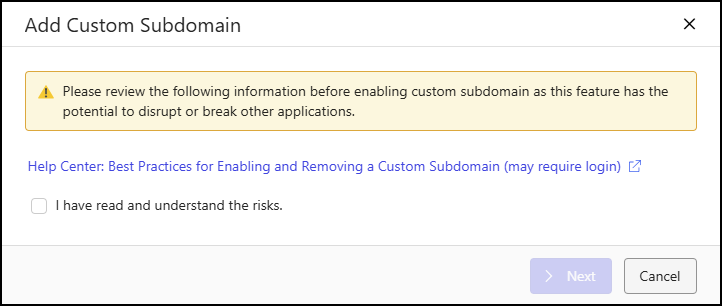
In the Add Custom Subdomain dialog, select the Help Center: Best Practices for Enabling and Removing a Custom Subdomain (may require login) link.
After you’ve reviewed the Help Center article, select the I have read and understand the risks check box, and then select Next.
To use a custom subdomain, slide the Use custom subdomain toggle to the right.
Figure: Add Custom Subdomain dialog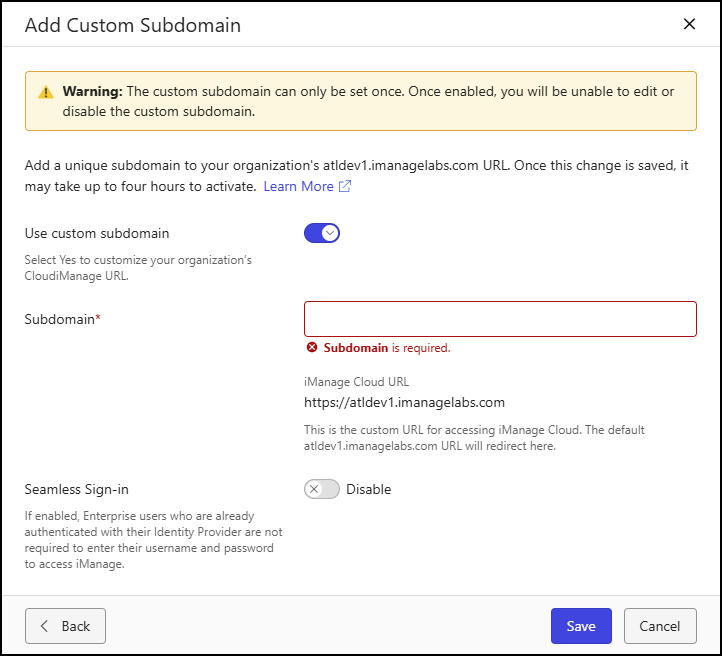
In Subdomain, enter the text for your custom subdomain.
Subdomains must be 2–63 characters.
Special characters are not allowed.
Dashes (-) are allowed, but can't be used as the first or last character.
Uppercase characters aren't allowed. If you enter an uppercase character, it's automatically converted to lowercase.
Subdomains must be globally unique. You'll receive a message notifying you if the subdomain you entered is already registered.
To enable seamless sign-in, slide the Seamless Sign-in toggle to the right. This allows Enterprise users to be immediately directed to their Identity Provider (IdP) for authentication without first needing to enter their email address on the iManage Work sign-in screen.
NOTE: When Seamless Sign-in is enabled, virtual users in iManage Work can no longer sign in using the usual method. Virtual users must instead connect using the following sign-in page: https://cloudimanage.com/auth/login.html.
You can also use this sign-in page for testing purposes to bypass single sign-on.
Select Save.
The new subdomain may take up to four hours to become active. Contact iManage Cloud Support if you require modification or removal of your custom subdomain.
TIPS: After adding a custom subdomain, you must also update the SAML/OIDC authentication configuration based on the new subdomain.
For instructions to configure SAML and OIDC SSO settings through iManage Control Center and your IdP, refer to Single Sign-On (SSO).
Use the new custom subdomain to download the metadata file, for example:
https://company.cloudimanage.com/auth/api/v1/saml/metadata/{customerId}